Walmart has been the first choice for most Americans looking for affordable yet high-quality products.
Most of these products are manufactured by other companies, and Walmart only sells the products they produce.
For those who are into photography, you could know about disposable cameras. You might want to use it to get the antique feeling or for your reasons, and you are wondering if Walmart can be your source. Let us get in the details and give you an answer;
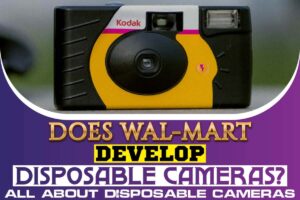
Does Walmart Develop Disposable Cameras?
Walmart develops disposable cameras, but it is done by third-party providers offsite. You will need to go to Walmart’s photo center and leave your disposable camera at the dropbox with an order form, so the film for your camera is processed.
You will have to wait for up to a week for the film to get to you, and you will pay $8 for the service.
Walmart Photo Center
After taking your pictures, you need a way to get them a hard copy or onto your phone. One of the best places to do this is the Walmart photo center.
You can get your pictures along with a new film all in one place. You can get the photos from your disposable camera or any other camera printed here.
The service is relatively quick, and you should have the pictures in about an hour. The prints are high quality, and they will make a good addition to your home décor.
You can even get photos from your iPhone and have them printed for you at Walmart with the convenience of your phone.
Using the 1 Hour Photo app on Apple App Store or the Same day Print app from Google Playstore.
Both these apps are free, and once installed, they will connect to your phone’s gallery. This will allow you to choose all the photos you want to print, and it will be done for you at Walmart Photo Center.
This is an advantageous feature since the order comes faster than before. After placing your photos, you can get the printed copies in an hour. This quick production produces high-quality pictures that you can put in an album or frame.
Using the apps also provides you with options to select the size of your photo. You can get a large size for a portrait or a smaller version to use in a scrapbook or the family album. Having more choices on what the final product looks like is a big selling point.
You can use Walgreens photo center to get your photos printed. You can send the photos directly from your phone to Walgreens and have them printed. With Walgreens, you can get the pictures, or you could have them delivered to you.
If you want another free printing option, you can use the FreePrints app, which you can download for free. Open the app and select the photos you want to print from your Instagram, Facebook, or gallery.
You will then need to specify the number of pictures you want and send the information. The photos will be printed on Fujifilm or Kodak paper, and they will be delivered to you in a few days. You can, however, use Walgreens if you want to avoid the wait.
How To Use A Disposable Camera
A disposable camera uses a film that can only be used once; it has to be replaced, hence the name.
Disposable cameras are a great way to have fun with your friends and keep amazing memories of times together. Here is how you can use a disposable camera:
The disposable camera itself is easy to use and doesn’t need any skills. If you are good at taking pictures with a smartphone or digital camera, you should have no problem using a disposable camera.
A disposable camera is entirely mechanical, which means that you do all the work and don’t need batteries.
Some brands have a flash that tells you that the camera is ready; these will need a battery to light the flash.
On the front of the camera, there is a switch for the flash if you want to use it. You can push it up and see a red flash come out on top of the camera. A flash will allow for better contrast for your photos, especially in poor lighting.
On the back of the camera, there is a dial that you move with your thumb. This will help you transition from one picture to the next. Use your thumb and rotate it until it locks so you know the film is ready for the next picture.
All you have to do to take a picture is press the button on top of the camera. You can take a picture with the flash off if you have too much brightness or don’t want it.
This camera works like a digital camera; there is a space to look at what you are taking a picture of at the back.
This is especially important since the number of pictures you can take is limited, so you have to get everything right.
At the top of the camera, next to the photo button, there will be some numbers. This indicates the photos you have left, and they will reduce each time you rotate the dial until it locks in place.
Why You Should Avoid Printing Film Photos At Walmart
You should avoid getting your film getting developed at a drugstore. By drugstores, I mean stores like Walmart, CVS, Walgreens, and any other store. They produce photos and can replace your film, but the quality might not always be the best.
The main reason for this is that they don’t do it on sight. Previously, you could go to CVS or Walmart and get your negatives produced in-house in an hour. Since the digital cameras took over, most stores stopped in-house film development.
This means that the store will only process your order, and they will ship your film out to a factory that does mass production.
Not much attention is paid to the film on such a large scale, and there is a decent chance you could lose the photos.
Most people complain about having scratches or dust on the photos they had printed at Walmart. This problem is because the offsite producers are not too keen on product quality.
The best option for you would be to take your photo to a professional photo-developing lab. There are some reputable options, such as the Dark Room lab, which will cost around $11.
This is a bit more expensive, but you will get better quality, and your pictures will not get lost. This is an option that works better since it is done online.
You will send the films to the studio, and they will get processed and posted on their online gallery for you to download. It will take between 5 and 7 days which is better than waiting three weeks for the same product.
Tips For Film Photography Beginners
Disposable cameras use films that have a limited number of photo slots. This limit means that you have to be careful when taking the pictures to avoid wasting the film. Here are some tips you will find useful as you use the film;
Store your film in the fridge. Your film deteriorates over time as it gets exposed to light, and it becomes unusable over time, and that is where the expiration date comes in. Storing the film in a fridge will reduce the rate of light sensitivity loss; thus, the film will last longer.
You can buy expired films to save your money. No guarantee that expired films won’t work, so for a beginner, you can buy the expired films and use them for practice without spending too much. You can then go to more expensive options when you are experienced.
Look at the age of the expired film before buying. If the film has expired for a year or less, it is probably still usable, but the viability reduces with the years.
It is also important to account for the store temperature since cooler temperatures mean a better film.
Keep the films away from heat or too much light. Heat will increase the rate of light sensitivity that your film has, and over time this might ruin your film. Light might cause some images to get onto the film, so it won’t be clear when you take a photo.
Conclusion
Walmart develops disposable camera films, but it is not done on sight. They use third-party factories to process their orders, so it could take a lot of time for them to be ready.
This long process could also mess with the quality of the pictures. Unless you are taking a picture of a reflective surface like a mirror, ensure you turn on the camera flash if you have one.
There is no technology in the disposable camera, so they are highly dependent on light, and the flash increases the light available to the camera.